IN THIS ARTICLE
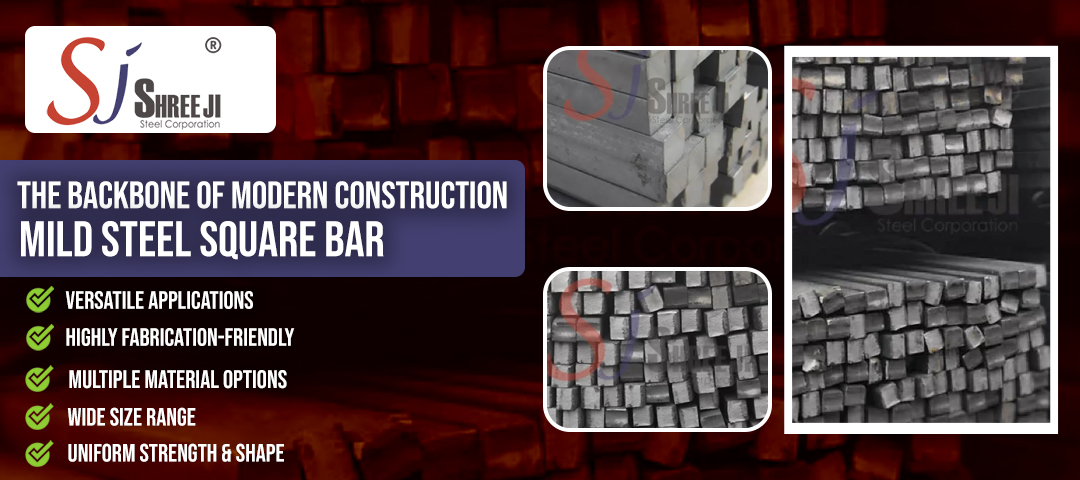
Square bars are among the most commonly used metal structures in modern industrial, structural, and construction designs. These bars have a uniform cross-section and are highly durable. Moreover, these metal structures are popular in construction works because they can be easily fabricated.
Thus, mild steel square bars are commonly used in the aerospace, automotive manufacturing, and construction sectors, where fabrication is necessary.
What are square bars?
It is a solid, straight metal rod with a square cross-section. These bars are made from various metallic materials, including stainless steel, mild steel, carbon steel, alloy steel, nickel alloys, and even titanium. The square bars are widely used for structural support. The standard range of an MS Square bar is 6mm to 75 mm.
These bars can withstand heavy loads without deforming. Hence, they are a reliable choice for the construction sector.
What are the different types of Mild Steel Square bars?
Stainless steel square bars
These bars have corrosion-resistant properties, combined with high mechanical strength and proper weldability. SS grades such as 304 and 316 are used in the food, marine, and chemical industries. Because of their robust nature, they are used in extreme conditions and for high-performance applications.
Alloy steel and carbon steel square bars
Alloy steel square bars, combined with chromium or molybdenum, are used in the construction industry. These square bars are strong and hard. Carbon steel options are strong, cost-effective, and ideal for structural applications.
Titanium square bars
These metal structures are popular for their high strength-to-weight ratio. These structures are corrosion-resistant. These square bars are generally used in the high-performance aerospace and medical industries.
Mild steel square bars
MS square bars are used widely in the construction industry. These metal structures are widely used in the general fabrication process. They are affordable, weldable and durable.
What are the standard sizes and weight charts?
Square bars are available in a range of side dimensions, ranging from 8×8 mm to 20×20 mm. The standard lengths range from 3 to 6 m. With the weight per meter in kg, the fabricators can calculate the amount of MS square bar required for the construction.
Here’s the weight chart for the same.
| Diameter in mm | Weight Per Meter in KG | Weight Per Foot in KG | Weight Per 6 Meter Pcs | Approximate Pieces in 1 Ton (single Piece Length 6 Meter) |
|---|---|---|---|---|
| 6mm | 0.283 | 0.09 | 3.40 | 294 |
| 8mm | 0.502 | 0.15 | 6.02 | 166 |
| 10mm | 0.785 | 0.24 | 9.42 | 106 |
| 12mm | 1.13 | 0.34 | 13.56 | 74 |
| 16mm | 2.01 | 0.61 | 24.12 | 41 |
| 18mm | 2.54 | 0.77 | 30.48 | 33 |
| 20mm | 3.14 | 0.96 | 37.68 | 27 |
| 22mm | 3.80 | 1.16 | 45.60 | 22 |
| 25mm | 4.91 | 1.50 | 58.92 | 17 |
| 27mm | 5.72 | 1.74 | 68.68 | 15 |
| 32mm | 8.00 | 2.44 | 96.00 | 10 |
| 34mm | 9.08 | 2.77 | 108.90 | 9 |
| 36mm | 10.20 | 3.11 | 122.40 | 8 |
| 38mm | 11.54 | 3.45 | 138.02 | 7 |
| 40mm | 12.60 | 3.84 | 151.20 | 7 |
| 42mm | 13.85 | 4.22 | 166.20 | 6 |
| 45mm | 15.90 | 4.85 | 190.80 | 5 |
| 50mm | 19.60 | 5.97 | 235.20 | 4 |
| 52mm | 22.05 | 6.72 | 264.60 | 4 |
| 65mm | 31.20 | 9.51 | 374.40 | 3 |
| 75mm | 44.10 | 13.44 | 529.20 | 2 |
The smaller sizes (8×8 mm to 12×12 mm) are generally lightweight, easy to handle, and hence preferred by fabricators. Again, a 10×10 mm bar at 0.79 kg per meter offers slightly higher strength; it is also more flexible, making it easily bent and machined as per the project’s requirements.
What are the common applications of square bars?
These bars are versatile and are used across different applications in different industries.
Construction industry
These bars are commonly used in construction projects for frames, brackets and base plates. A uniform cross-section helps maintain uniform load distribution in all directions. Thus, these structures are crucial for providing proper load-bearing capacity.
On construction sites, larger square bars (such as 32×32 mm or 40×40 mm) are often used in temporary structural supports. Square bars of these sizes are also used for shed and warehouse frameworks.
Automotive and transportation industry
The combination of high-grade alloy and nickel alloy square bars is used in environments where severe corrosion, high heat, and stress are present. Square bars are commonly used in vehicle chassis subframes, seat mounts, and suspension brackets.
Again, in railway workshops, they are used for equipment support and mounting brackets due to their easy alignment and durability.
Engineering and heavy industries
These bars are widely used in the heavy machinery industry for their robustness and load-bearing capacity. Especially in power plants and steel mills, square bars are widely used for machine bases, conveyor supports, and lifting frames. Large square bars (40×40 mm and above) are commonly used in the fabricated frames of heavy-duty machinery.
Aerospace and engineering industry
Square bars can withstand extreme temperature changes and mechanical stress. Thus, the bars are used for structural supports, brackets, and internal framework in the aerospace industry. The Nickel alloy square bars are often selected for engine mounts and high-temperature zones because they remain strong and unchanged under heat and pressure.
Why is it important to choose the right material for the square bar?
Fabricators and industries should choose the right material grade for square bar to ensure durability, safety, and cost efficiency. Environmental factors such as corrosion resistance, operation under extreme temperatures, and mechanical stress should be considered during material selection. Wrong selection leads to premature support failure.
The table below compares commonly used square bar materials.
| Material Grade | Corrosion Resistance | Heat Resistance | Strength Level | Common Applications | Real-Life Examples |
|---|---|---|---|---|---|
| Mild Steel (MS) | Low | Moderate | Medium | General fabrication, construction, frames | Window grills, stair railings, warehouse structures |
| Carbon Steel | Low–Moderate | High | High | Structural and load-bearing applications | Bridges, machine frames, support columns |
| Stainless Steel (304) | High | Moderate | Medium-High | Corrosive and hygienic environments | Food processing equipment, kitchen structures |
| Stainless Steel (316) | Very High | High | High | Marine and chemical environments | Coastal railings, chemical plant supports |
| Alloy Steel | Moderate | Very High | Very High | High-stress and high-temperature use | Automotive shafts, heavy machinery components |
| Nickel Alloy | Excellent | Excellent | Very High | Extreme environments | Aerospace parts, heat exchangers |
| Titanium Alloy | Excellent | Very High | Very High (Lightweight) | High-performance and weight-critical uses | Aircraft frames, medical implants |
For general construction and support structures, mild steel square bars are economical; in moisture-prone zones, stainless steel grades are a better option. Nickel and titanium alloys, on the other hand, are used primarily for advanced engineering applications. The contractors mostly choose alloy or carbon steel square bars because they exhibit superior strength and adequate fatigue resistance.
Square bars are thus an important component of every construction project. Their durability, uniform geometry, and adaptability make them a popular choice for the construction, heavy engineering, and automotive industries. Whether it’s mild steel or a high-grade alloy, selecting the right material helps contractors provide proper support components.
Are you looking for good-quality MS Square Bar? At Shree Ji Steel, we are a leading distributor and supplier of mild steel square bars. We offer a wide range of MS square bars in different grades, sizes, and finishes, catering to diverse customer needs.
FAQs
How to choose the right square bar for my project?
To choose the right square bar, the contractors need to check the load-bearing capacity, application type, and structural design. Smaller sizes (8×8 mm to 12×12 mm) are suitable for light fabrication. On the other hand, medium sizes (16×16 mm to 25×25 mm) work well for frames and supports. Larger sizes, such as 32×32 mm to 50×50 mm, are available for heavy-duty structural and industrial applications.
What is the square bar weight per meter important in construction?
The weight per meter helps in calculating the total material quantity. When you estimate weight accurately, you can achieve equal load distribution and support budgeting and logistics.
What is the difference between mild steel and stainless steel square bars?
Mild steel bars are cost-effective and easy to fabricate. On the other hand, stainless steel bars are well-suited for outdoor construction structures because they are corrosion-resistant.