IN THIS ARTICLE
- What is L Angle and How Does It Play a Crucial Role?
- What is GI L Angle?
- What is the Standard L-angle, and what are the Benefits of the Standard L-angle?
- What is Custom L-angle and Why Should You Consider Them?
- When Should You Opt for a Standard L-angle?
- When Should You Opt for a Customised L-angle?
- GI L Angle vs. L Angle: Which One to Choose?
- FAQ
Planning the structure and strengthening the foundation of any real estate project is crucial. It controls the stability, durability, and lifespan, and in this, the L Angle and GI L Angle (galvanised iron L Angle) play a crucial role. These components ensure stability and longevity.
Choosing between two for a project is not a straightforward decision. Various aspects, including the advantages and disadvantages of these two, are mandatory to make an informed decision.
What is L Angle and How Does It Play a Crucial Role?
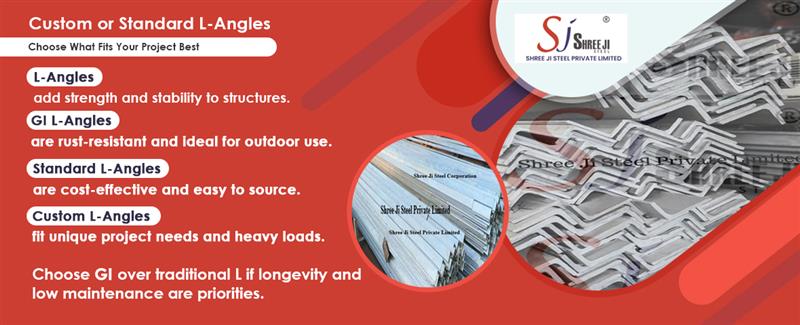
L Angel is essentially an “L” shaped steel component, also known as an angle iron or angle bar. It is widely used in construction and framing. It offers structural stability and exceptional strength. This capability makes the L-angle one of the indispensable components in the construction industry.
L-angles are frequently used to reinforce beams, columns, and trusses in buildings and bridges, helping to distribute weight and withstand heavy loads. In structural frameworks, L-angles are used for diagonal bracing to resist lateral forces from wind or seismic activity. This prevents a structure from twisting or swaying. It is also widely used for roof trusses and other framed structures. These angles are a cost-effective and lightweight option. They provide excellent axial-flexural capacity and resistance to buckling.
What is GI L Angle?
When an L-angle is built with galvanised iron, it is called the “GI L Angle”. Galvanisation offers an extra layer of protection, making them corrosion-resistant. Hence, the GI L-angles are the best for outdoor and moisture-prone environments.
What is the Standard L-angle, and what are the Benefits of the Standard L-angle?
Standard L-angles come in predetermined sizes, thickness and material grades. These angles are specified according to the Indian Standard, IS 2062. It is the specified standard for Hot-Rolled Medium and High-Tensile Structural Steel. It covers various grades, such as E250, E350, and E410.
Benefits of Standard L-angle
- Cost-effective and easily available throughout the year.
- A wide range of options is available for different usages.
- Minimal lead time for procurement.
- Easily pairs with most standard fittings and bolts.
What is Custom L-angle and Why Should You Consider Them?
Custom L-angles are dedicated, planned and made for your unique project requirements. Naturally, length, thickness, material grade and leg size can be altered accordingly.
Advantages of Custom L-angle
- Planned dimensions for every project.
- Can handle specific load conditions efficiently.
- Weight and material use can be optimised.
- Higher flexibility in aesthetics and project constraints.
When Should You Opt for a Standard L-angle?
If the project design is common and requires only typical components, you can easily opt for the standard L-angle. Additionally, it helps keep the project expenditure under budget and complete it faster.
When Should You Opt for a Customised L-angle?
Are you planning a unique layout project in a region which faces harsh weather conditions? If the answer is assertive, going for a tailored L-angle is mandatory. A customised component enables the structure to bear a unique load, withstand weather-related issues, and meet the specific demands of a project.
GI L Angle vs. L Angle: Which One to Choose?
Choosing between the GI and traditional L depends on your project area. If you are working in a humid area, opt for a GI one. As these components are galvanised, they tend to prevent rust and corrosion. GI L-angle indeed comes with significant upfront costs, but it requires lower maintenance costs and offers a higher lifespan. This feature makes it one of the most cost-effective choices for projects.
To choose between GI L-angle and L-angle, you need to consider budget, location and longevity expectations. Consider all aspects carefully and make a future-ready decision.
Do you still require the right guidance? Contact us. At Sreeji Steel Private Ltd, we offer various angles, including galvanised ones, at a competitive rate.
FAQs:
Do the custom L-angles cost more?
Yes, the custom L-angles cost more than the standard ones, as they are built to meet special demands. However, it is an investment because its unique dimensions help support the structure ideally and strengthen the core.
Do I require you to pay foresight charges?
Yes, at Sreeji Steel Private Ltd, we charge for foresight separately, and the cost largely depends on the quantity, location, and vehicle. Commonly, loose-packed and bundle packing is possible (on request and subject to availability).
Can I get a galvanised angle?
Yes, we offer standard galvanised angles. Here is a glimpse of our offering:
| Additional Information | |||
|---|---|---|---|
| Country Of Origin | Made in Bharat (INDIA) | ||
| Material Used in Electroplating | Zinc | ||
| Galvanising Material | IS 17404 : 2020 | ||
| IS Classification Group | Metals, Alloys, and Metal Products (including Steel Products) | ||
| Test Certification Availability | No | ||
| Zinc content | 92-95% metallic Zinc in dry film | ||
| Process of Coating | Electroplating | ||
| HSN Code | 7216 | ||
| Base Material | Cold-rolled or Hot-rolled Carbon steel | ||
| Minimum Order Quantity | 25 Ton | ||