IN THIS ARTICLE
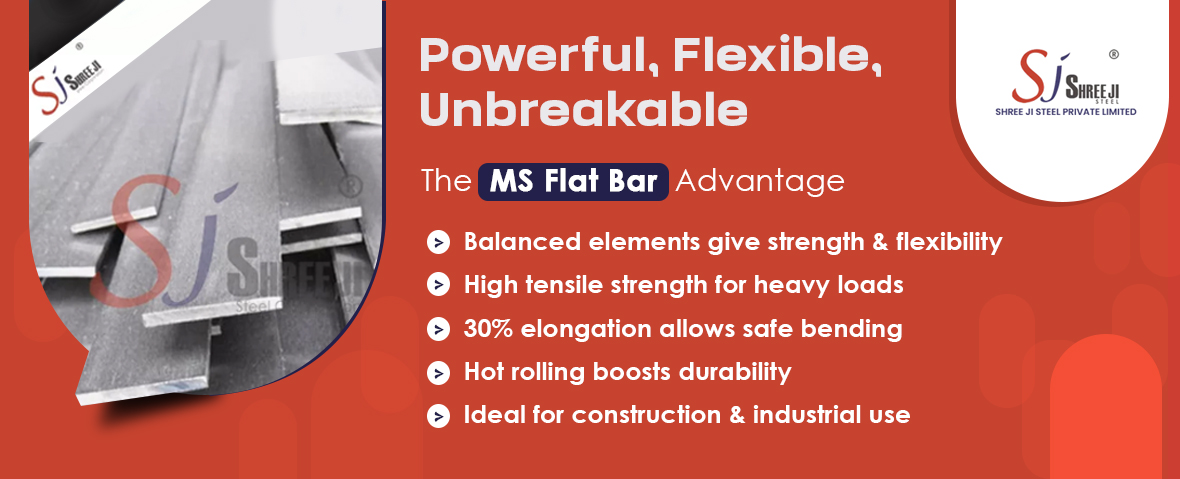
MS Flat Bar is a crucial material in construction and engineering due to its unique combination of strength and flexibility. It is also used extensively in its frameworks, machinery, and industrial structures to ensure heavy loads are not deformed by the metal. The trick of this performance is in the fact that the chemical composition and mechanical properties are carefully controlled. Achieving reliability, durability, and workability in a variety of applications, Mild Steel Flat Bar relies on balancing its elements, including carbon, manganese, and silicon, and using the processes that are more precise. The knowledge of these factors aids professionals to choose the appropriate material in a project where endurance and flexibility are the main requirements.
What Chemical Elements Make MS Flat Bars Strong and Flexible
It is the chemical composition of MS flat bars that forms the centre of stage in determining their mechanical performance. The most important elements and the maximum values are:
| MS FLAT BAR CHEMICAL COMPOSITION: (IN % MAXVALUES) | |||||
|---|---|---|---|---|---|
| Carbon % | Manganese Max % | Sulphur Max % | Phosporous Max % | Silicon Max % | Carbon Equivalent |
| 0.2 | 0.56 | 0.049 | 0.069 | 0.18 | 0.277 |
- Carbon gives the steel strength in terms of its resistance to external forces.
- Manganese increases wear life and strength making it to last longer.
- Silicon adds to elasticity and the steel is able to bend without cracking.
- The low level of sulphur and phosphorus inhibits brittleness and enhances the general toughness.
- Carbon equivalent allows weldability and also the strength is maintained.
This exact ratio of components enables MS flat bars to stay strong in tensile properties and at the same time flexible enough to bend and shape.
How Do Mechanical Properties Support Strength and Flexibility?
In determining the performance of MS flat bars, mechanical properties also play an equally significant role. The mechanical properties that are likely to be met are as follows:
| MS FLAT BAR MECHANICAL COMPOSITION: (IN % MAXVALUES) | |||
|---|---|---|---|
| Tensile Strength Min, MPa | Yield Stress, Min, MPa | % Elongation | Bend Test |
| 456 | 295 | 30.1 | OK |
- Tensile strength of 456 MPa allows the material to handle substantial pulling forces without failure.
- Yield stress of 295 MPa ensures the bar can support heavy loads without permanent deformation.
- Elongation of 30.1% indicates flexibility, enabling it to bend safely under stress.
- Bend tests confirm the steel can be shaped or formed without cracking.
Collectively these properties ensure a stable compounding of endurance as well as flexibility in building and industrial practice.
How Do Manufacturing Processes Enhance MS Flat Bar Performance?
- Hot Rolling: Aligns internal grains for uniform strength and a smooth surface.
- Controlled Heat Treatment: Strengthens the steel’s internal structure, improving hardness and resistance to deformation.
- Quality Assurance: Mechanical tests during production ensure consistent tensile strength, elongation, and flexibility.
By combining chemical composition with these processes, MS flat bars achieve the perfect balance of strength and flexibility.
Why Are MS Flat Bars Preferred in Construction and Industry?
The construction and industrial projects are common with the use of MS flat bars because of their special combination of a high tensile strength and flexibility. They are trustworthy when it comes to support structures and structural elements, whereby buildings and machineries are capable of taking up heavy loads without sustained deformations. The robustness of the material provides its applicability to the industrial machine and transport system, where the robustness and flexibility of the material are of paramount importance. Also, it can withstand stress cracking and warping hence making MS flat bars an essential part of the project requiring durable and tough materials. This toughness and workability are the balance that guarantees their further popularity in most applications.
Shree Ji Steel Private Limited offers steel products that are in line with the performance standards. They pay more attention to quality, accuracy, and durability so that every MS flat bar promotes the long-term construction and industrial installations. Select them to make sure that your materials will work well when subjected to harsh environments. For a clearer understanding of their product strength and applications, you can also watch this detailed video here: https://youtu.be/bnlUQZq4Owc?si=9OHO9FJeJmRsPgtI
FAQs
-
What is the main factor behind MS flat bar’s strength?
This is because the strength is a result of a blend of carbon, manganese, and silicon content, and regulated processes during production, such as rolling and heat treatment.
-
Can MS flat bars bend without breaking?
Yes, MS flat bars are bendable to a safe level in that it can be bent with an elongation rate of approximately 30 percent and it can pass bend tests.
-
Where are MS flat bars most commonly used?
They are used in construction frameworks, industrial machinery, transport structures, and general fabrication where durability and flexibility are required.
-
How does carbon equivalent affect performance?
Carbon equivalent makes it weldable and it is also strong so that the steel can be shaped or joined without loss of its structural integrity.