IN THIS ARTICLE
In construction, fabrication, or automotive applications, the MS chequered plate is widely used. It is a material known for its anti-skid surface, durability, and versatility. Depending on your requirements, manufacturers may offer material for a bulk purchase. Now, it is quite natural to be curious about the price and what may affect it.
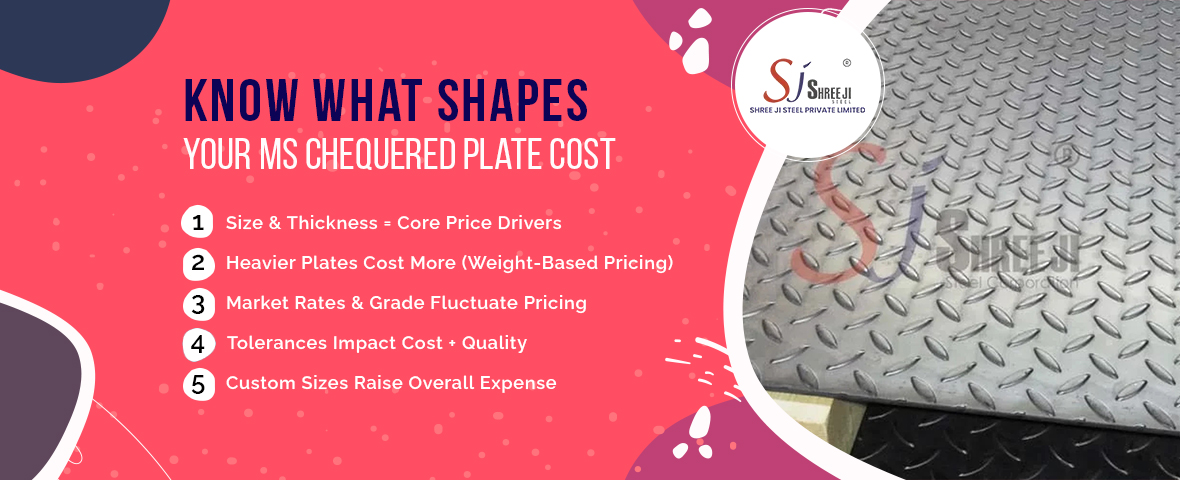
According to experts, the price of MS Chequered Plate depends primarily on size, weight, and thickness. However, additional factors, such as grade, tolerance, and market steel rates, can also be observed. Understanding the factors may help make an informed decision.
How Does Size Influence the MS Chequered Plate Pricing?
Size is certainly one of the prime factors that affect the pricing of steel plates. It is usually priced per square foot, square metre, or kg or ton. If it is a large plate, it may require more volume, increasing the overall cost.
Some of the common sizes are widely available. Due to mass production, the material may be available at a lower price. If a custom-sized plate is required, the price may increase naturally. By speaking with the experts and discussing the project dimensions, it is possible to get an exact price quote. Potential wastage, additional labour, and machining may also increase the price. Optimised size use may reduce waste and ensure value for money, especially for fabrication, flooring, or heavy-duty industrial projects.
What Role Does Weight Play in Deciding MS Chequered Plates Cost?
Weight definitely affects the cost. Most manufacturers sell Mild Steel Chequered Plate by weight rather than by piece count. When thickness increases, weight may also increase, raising the overall cost. The pattern on the plate requires additional steel, which may increase the plate’s weight.
For load-bearing and high-impact applications, thicker plates are required. It is usually utilised for the trenches, vehicle decks, and industrial walkways. Despite being costly, it may deliver a stronger, more durable surface. A clear understanding of the weight may help create a precise budget, reducing the risk of cost differences.
| CHEQUER PLATE WEIGHT | |||
|---|---|---|---|
| Item | Diameter in mm | Weight Per Square Meter In KG | Weight Per Square Foot in KG |
| MS CHEQUERED PLATE | 2.5mm | 20 | 6.13 |
| MS CHEQUERED PLATE | 3mm | 24 | 7.38 |
| MS CHEQUERED PLATE | 4mm | 32 | 9.81 |
| MS CHEQUERED PLATE | 5mm | 41 | 12.34 |
| MS CHEQUERED PLATE | 6mm | 49 | 14.78 |
| MS CHEQUERED PLATE | 8mm | 65 | 19.78 |
| MS CHEQUERED PLATE | 10mm | 81 | 24.66 |
Do the Market Rate and Material Grade Affect the Price?
Yes, both the base metal pricing and grade can impact the cost. Most of the MS Chequered Plates are graded IS 2062. However, materials such as carbon and iron ore prices may fluctuate, significantly altering the plate’s total cost. In addition, logistics, labour, manufacturing energy costs, and the supply-demand cycle can significantly influence market prices.
How Tolerances Change the Pricing and Quality?
Tolerances indicate acceptable variations in thickness, dimensions, and weight during the manufacturing process. A small difference in the tolerances can impact the final price. It also affects the performance, precision and weight per square metre. Reputed manufacturers usually adhere to the standards. However, the price may change due to the use of advanced equipment, compliance, and testing.
| ROLLING TOLERANCES OF MS CHEQUERED PLATE | |||
|---|---|---|---|
| Depth | Tolerance | Width of flange | Tolerance |
| Up to 200 mm | ± 2.5 mm | Up to 100 mm | ± 2 mm |
| > 200 to 400 mm | ± 3.0 mm | ||
| Tolerance on weight per meter shall be ± 2.5% or alternatively +4, -1% of the standard weight per meter. The permissible limits for camber and sweep shall be 0.2% of the length. |
|||
For large-scale industrial projects, adherence to standards ensures consistent installation and structural safety. Choosing a plate manufactured to a certified tolerance may significantly reduce installation issues. It may become a reliable option at the same time.
Can Custom Fabrication Impact the Final Price?
Standard sizes are usually economical. For special projects, it is necessary to consider dimensions, weight optimisation, and transportation. Custom cutting requires additional workforce and handling of resources and machinery, which may increase the total price.
To make a smarter decision, it is better to be aware of the MS Chequered Plate’s size, thickness, and weight. Based on the project requirements, experts may assess the weight chart, grade standards, and tolerances to provide an estimate of the overall price. Contact our experts at Shree Ji Steel Pvt Ltd for high-quality materials at a budget-friendly price.
FAQs
Is It Better to Use a Thicker Chequered Plate?
Not necessary. It is better to determine the thickness of the MS Chequered Plate based on the project’s usage. For residential or light industrial flooring, chequered plate with a 3mm or 4mm Thickness may be suitable. For the heavy-duty ramps, the Thickness can be about 8mm or 10mm.
Why does a Different Supplier offer a Different Price for the Same Size?
Differences in the steel grade, brand reputation, stock availability, and surface finish may influence the price.
Is there a cost difference between the standard-size and custom-sized plates?
The standard option is usually more affordable than custom-sized MS Chequered Plates.