IN THIS ARTICLE
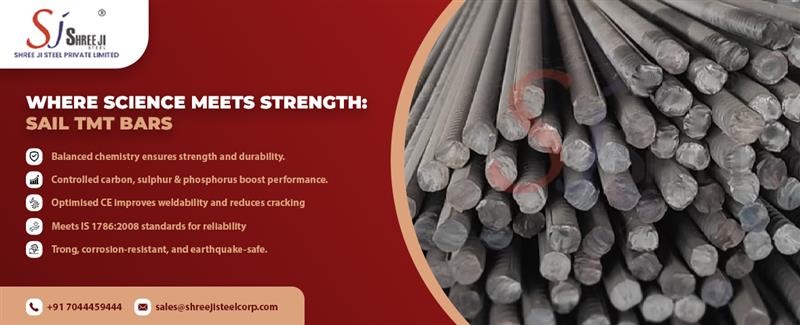
When prioritising safety, strength, and longevity, it is better to trust a high-quality option from SAIL for TMT Bars. Since the Steel Authority of India makes these bars, you can get top-notch performance for every possible structure. For high-rise buildings, bridges, and even homes, there is no better option than SAIL TMT Bars.
It is beneficial to understand what sets them apart from other options available on the market. Thanks to the advanced manufacturing process, it has become possible to ensure a balanced chemical composition. TMT bars with proper chemical balance can ensure strength, durability and rust resistance.
What is the Role of Chemical Composition in the SAIL TMT Bars?
TMT is an acronym for Thermo-Mechanically Treated, which means that the bar undergoes a special treatment to achieve a harder outer layer. However, the core is usually ductile and soft. The balance between carbon, nitrogen, sulphur and phosphorus determines how it may perform under pressure.
SAIL adheres to the IS 1786:2008 standards for the TMT bar. Due to a focus on chemical balance, it may not be difficult to guarantee an optimum strength and longevity for any construction project.
What is the Chemical Composition of SAIL TMT Bars?
A detailed examination of the chemical properties across various TMT bar sizes can provide insight into whether it meets the high-performance benchmark set for the project.
| CHEMICAL COMPOSITION OF TMT STEEL BARS | ||||||
|---|---|---|---|---|---|---|
| SAIL TMT bars are made from high-quality iron ore and undergo strict quality checks. The bars are Thermo Mechanically Treated (TMT) to give them the required characteristics. |
||||||
| Chemical Properties of SAIL TMT | ||||||
| Sizes | Carbon (%) | Sulphur (%) | Phosphorus (%) | Sulphur & Phosphorus (%) | % C.E | Nitrogen Content |
| 8mm | 0.16 | 0.021 | 0.036 | 0.057 | 0.260 | 0.0090 – 0.0100 |
| 10mm | 0.21 | 0.025 | 0.038 | 0.063 | 0.280 | 0.0090 – 0.0100 |
| 12mm | 0.19 | 0.030 | 0.041 | 0.071 | 0.260 | 0.0090 – 0.0100 |
| 16mm | 0.20 | 0.026 | 0.040 | 0.066 | 0.300 | 0.0090 – 0.0100 |
| 20mm | 0.18 | 0.031 | 0.035 | 0.066 | 0.300 | 0.0090 – 0.0100 |
| 25mm | 0.13 | 0.027 | 0.071 | 0.098 | 0.240 | 0.0090 – 0.0100 |
| 32mm | 0.14 | 0.028 | 0.072 | 0.099 | 0.250 | 0.0090 – 0.0100 |
How Does Each Chemical Add to the Strength?
How Carbon Enhances the Strength?
Carbon adds to the tensile strength. However, it may reduce the ductility. Due to these reasons, experts recommend keeping the carbon range between 0.13% and 0.21%. It strikes a balance between flexibility and strength. Thanks to this feature, the design for the construction becomes earthquake-resistant.
Why Should the Phosphorus and Sulphur Amounts Be Controlled in SAIL TMT Bars?
Excess of sulphur and phosphorus can lead to cracking and bitterness. Therefore, it is better to keep both elements to a minimum. On occasion, the sulphur level should stay between 0.021% and 0.031%. In the case of phosphorus, the concentration can range from approximately 0.035% to 0.072%. A proper balance of these chemicals may offer superior weldability, toughness, and corrosion resistance.
How Important is Carbon Equivalent and Nitrogen?
From approximately 0.240, the carbon equivalent (CE) can increase to 0.300. It decides the weldability of the steel. If the CE is lower, it means that there will be fewer chances of cracking. In the case of Nitrogen, the amount between 0.0090 and 0.0100 is best for maintaining strength without hampering the level of flexibility.
Why Should the Chemical Composition of SAIL TMT Bar Be Controlled?
With the optimised level of manganese and carbon, the TMT bars offer a better yield and tensile strength. If there is low sulphur and phosphorus, the structure may be able to resist corrosion. Control with the CE delivers flawless weld joints. Elongation absorbs the seismic shock to deliver earthquake resistance.
A proper balance of the chemical composition not only makes it strong but also guarantees stability, safety, and endurance with every project.
In conclusion, the chemical composition of the SAIL TMT Bars is the reason behind the high-end flexibility, strength, and durability. The use of advanced technology and metallurgical expertise makes these bars distinct from others. Over the years, SAIL has become the backbone of the infrastructure. Therefore, it is possible to get a safe, strong, and built-to-last option.
Shree Ji Steel Pvt Ltd offers a wide range of SAIL TMT Bars, including Fe500D, Fe550D, EQR, and SeQR in diverse sizes such as 8mm, 10mm, 12mm, 16mm, 20mm, 25mm, 28mm, and 32mm. Contact us to get the finest quality.
FAQ
Why Does the Chemical Composition of TMT Bars Matter?
The chemical composition of the TMT bars is crucial, as it directly affects their strength, flexibility, and resistance to corrosion. A balanced composition ensures that the steel can withstand both heavy loads and environmental stress without compromising its integrity.
Are SAIL TMT Bars Suitable for Coastal or Humid Regions?
Yes. The low sulphur and phosphorus content in SAIL TMT Bars makes them highly resistant to rust and corrosion. Therefore, it can be ideal for coastal or moisture-prone areas.
How to Verify the Authenticity and Quality of SAIL TMT Bars?
Check for SAIL branding on the bars, IS 1786:2008 marking, and purchase only from authorised SAIL dealers, such as Shree Ji Steel Pvt Ltd, to ensure you receive genuine, tested products.