IN THIS ARTICLE
The modern construction industry continually strives to enhance the durability of its projects. To achieve this goal, industry experts continually seek materials that combine strength, efficiency, and versatility. In this hunt, many components have been discovered. Wide Flange Parallel Beams (WPB) stand as an indispensable element. Known for durability and adaptability, the WPB is the backbone of the modern construction industry.
How Do the Wide Flange Parallel Beams (WPB) Combining Strength With Flexibility?
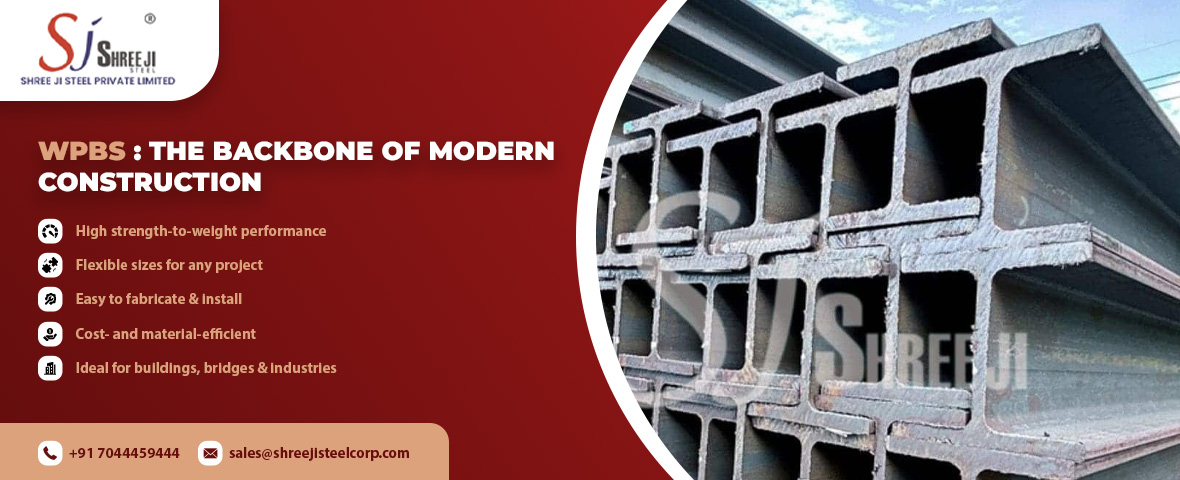
A WPB is often referred to as a universal beam (UB) or H beam. Its name has been inspired by its distinctive cross-sectional shape, which resembles the letter “H”. Unlike traditional beams, A WPB is flat in the web and flanges and maintains uniform thickness along the length of the beam. This unique build and design offer these beams superior load-bearing capabilities and a simplified connection process during fabrication and erection.
The WPBs not only exhibit excellent resistance to bending but also perform extremely well under pressure. Hence, it efficiently optimises the material usage in the construction. This feature is making the WPB an ultimate choice for quality architects and builders.
What are the Advantages of WPB in Modern Construction?
Unparalleled Strength-to-Weight Ratio
WPBs offer excellent strength without unnecessary mass. The unique geometry offers strong resistance to bending, allowing engineers to design a lighter structure without compromising performance. The strength-to-weight ratio is highly valuable for high-rise buildings, bridges, and industrial frameworks.
Higher Flexibility of Design
WPBs are available in a wide range of sizes and grades. Depending on the demand for construction, they can be used in various ways. For instance, the 160 mm × 160 mm WPBs are ideal for offshore construction, as they withstand extreme loads and harsh ambient conditions, such as those found on oil rigs and wind turbines. On the other hand, 240 mm x 240 mm WPBs are ideal for large-scale constructions. It includes shopping malls, exhibition centres, and industrial structures where wide, open, unobstructed spaces are required.
Easy Fabrication and Installation
WPBs are easy to fabricate and install at the location. Bolting, welding, and riveting are extremely straightforward with this component. This easy handling results in reduced labour time and potential errors. It also contributes to faster project completion, which adds significant leverage in the competitive market.
Cost and Material Efficiency
WPBs have a much higher load-bearing capability than traditional beams and require fewer projects. It helps reduce catering costs, transport, and handling expenses. Furthermore, the market is filled with recycled WPB, and they have similar features. The use of recycled items helps reduce the overall budget and promotes sustainability in the construction industry.
What Are the Applications of WPBs in Modern Construction?
Commercial and Residential Buildings
WPBs are highly popular for commercial and residential buildings. The high load-bearing capability makes it ideal for supporting floors, roofs, and mezzanines. Additionally, its exceptional strength-to-weight ratio allows experts to use it for open-plan layouts with fewer intermediate supports.
Industrial and Manufacturing Units
Industrial and manufacturing units operate in harsh environments and require robust and reliable components; the WPB is that. From warehouse frameworks to heavy-duty manufacturing plants, WPBs serve excellently as skeletal structures. They support overhead cranes, conveyor systems, and heavy machinery.
Infrastructure and Transport Industry
WPBs are indispensable in bridges, flyovers, railway stations, and airport terminals. Its higher resistance to bending helps in withstanding the thrust of vehicles, trains, and aircraft.
Educational, Healthcare, and Public Buildings
Safety and functionality are paramount in schools, hospitals, and civic centres. The WPBs offer the required strength and stability. Their flexibility also allows architects to explore diverse design styles.
Miscellaneous Sectors
Due to higher durability, flexibility and strength, the WPB is widely popular in various architectural sectors. It includes renewable energy, modular construction, and other sustainable practices.
Wide Flange Parallel Beams or WPBs are now a requisite component in the modern construction industry. The combination of strength, efficiency, and adaptability makes it a cornerstone of contemporary structural design.
Are you looking for a reliable vendor for high-grade WPBs? Contact us. At Shree Ji Steel Pvt Ltd, we offer a range of SAIL WPB sizes and grades, renowned for their trusted quality in the construction industry. Contact us to place the order now.
FAQs
Is WPB available in different sizes?
Yes, we offer a wide range of WPBs suitable for various industries. They are available in different grades and sizes.
| WPB Chart | |||||||
|---|---|---|---|---|---|---|---|
| Item | European Beam Standard |
Size (in mm) | Weight Per Meter In KG |
Weight Per Foot In KG |
Weight Per 12 Meter Pcs |
Number of Pieces In 1 Metric Ton |
Approx. Running Meter Length In 1 Ton |
| WPB 160 | HE 160 AA | 160x160mm | 22.75 | 6.93 | 273 | 3.66 | 43.96 |
| WPB 160 | HE 160 A | 160x160mm | 30.44 | 9.28 | 365 | 2.74 | 32.85 |
| WPB 160 | HE 160 B | 160x160mm | 42.59 | 12.98 | 511 | 1.96 | 23.48 |
| WPB 160 | HE 160 M | 160x160mm | 76.19 | 23.22 | 914 | 1.09 | 13.13 |
| WPB 200 | Standard | 200x200mm | 37.34 | 11.38 | 448 | 2.23 | 26.78 |
| WPB 200 | HE 200 AA | 200x200mm | 34.65 | 10.56 | 416 | 2.41 | 28.86 |
| WPB 200 | HE 200 A | 200x200mm | 42.26 | 12.88 | 507 | 1.97 | 23.66 |
| WPB 200 | HE 200 B | 200x200mm | 61.30 | 18.68 | 736 | 1.36 | 16.31 |
| WPB 240 | HE 240 AA | 240x240mm | 47.40 | 14.45 | 569 | 1.76 | 21.10 |
| WPB 240 | HE 240 A | 240x240mm | 60.32 | 18.39 | 724 | 1.38 | 16.58 |
| WPB 240 | HE 240 B | 240x240mm | 83.20 | 25.36 | 998 | 1.00 | 12.02 |
| WPB 240 | HE 240 M | 240x240mm | 156.68 | 47.76 | 1880 | 0.53 | 6.38 |
| WPB 300 | HE 300 AA | 300x300mm | 100.85 | 30.74 | 1210 | 0.83 | 9.92 |
| WPB 300 | HE 300 B | 300x300mm | 117.03 | 35.67 | 1404 | 0.71 | 8.54 |
| WPB 300 | HE 300 M | 300x300mm | 237.92 | 72.52 | 2855 | 0.35 | 4.20 |
What is the tolerance of WPB?
Although we have a wide range of WPB and tolerance offers, the common and popular WPB are E-250 and E-35; they have a tolerance of +/- 2.0 mm in the case of beams less than 100 mm in width and +/- 2.5 mm in the case of flange width between 100 mm and 125 mm. Additionally, +/- 4.0 for flange width 125mm to 250mm. Connect with us to learn about the other WPBs and their tolerance.
Are WPBs corrosion-resistant?
Typically, the standard WPBs are not inherently corrosion-resistant. However, if you treat them with a galvanised, painted, or coated finish for protection, they prevent corrosion.