IN THIS ARTICLE
Steel beams are an important component used in infrastructure, construction and industrial projects. In warehouse, bridge, and factory shed construction, beams play a significant role. With the right beam, the project’s durability, stability, and strength can be ensured. I-Beams and ISMB are two common terms used by engineers and contractors during construction projects. However, buyers should understand the difference before making a decision.
What is an I-Beam?
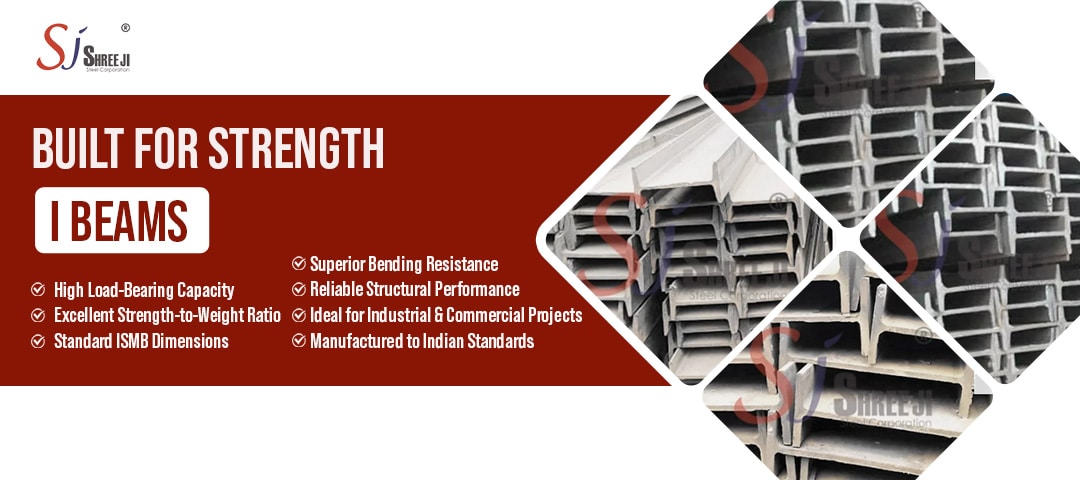
It is a structural steel named after the cross-sectional shape, which resembles the capital letter “I”. It consists of:
- Two horizontal beams called flanges
- One vertical beam called the web
- Fillets in between the web and flanges to connect both
I Beam helps to handle:
- High bending forces
- Excellent strength-to-weight ratio
What does ISMB mean?
ISMB stands for Indian Standard Medium Beam. It is a type of I-beam manufactured in accordance with Indian standards and IS:808 specifications. While every ISMB is an I Beam, every I Beam is not an ISMB, as not every I Beam is manufactured according to the specifications.
ISMBs are commonly used for structural construction in India because they are designed to Indian dimensions and manufactured with adequate load-bearing capacity.
Where are I-Beams commonly used?
I-Beams are commonly used in the following projects:
- Multi-storeyed buildings
- Industrial sheds
- Warehouse sheds and structures
- Factory buildings
- Flyovers and bridges
- Railway platforms
Since I-Beams can support heavy loads over long spans, they are ideal for the aforementioned structural applications.
Common ISMB sizes
The common length option for ISMB is 11-13 meters, with a fixed length of around 6/12 meters. Some of the popular ISMB-sized include:
ISMB 100 × 50 mm
ISMB 150 × 75 mm
ISMB 200 × 100 mm
ISMB 250 × 125 mm
ISMB 300 × 140 mm
ISMB 400 × 140 mm
ISMB 500 × 180 mm
ISMB 600 × 210 mm
Most trusted steel suppliers follow standardized dimensions, making procurement easier for engineers and contractors.
How are I-Beam and ISMB different?
Category of beams
While I-Beam refers to the shape of the beam, it is a broad term used to describe the general category of all steel beam sections with an I-shaped cross-section. Various countries manufacture different types of I-beams according to their standards.
ISMB follows Indian standards and is a specific type of I-beam within the general category of I-Beams. ISMB beams are designed according to IS:808 dimensions and are commonly manufactured using the IS 2062-grade steel.
The standardisation is done to:
- Simplify the structural design according to the requirements of Indian construction projects
- Ensuring quality compliance of the Beams for structural project purposes
- Reduction of procurement challenges from the perspective of contractors and construction owners
Availability and compatibility
Since the ISMB beams are designed in accordance with Indian standards and specifications, they are widely stocked by steel suppliers in India. Thus, procuring ISMB is easier than procuring I Beams. This helps to reduce project delays. Most Indian construction projects require ISMB beams per the project specifications.
Flange thickness
The thickness of I-Beams varies widely because they are universal beams with tapered or parallel flanges. ISMB, on the other hand, has sloping inner flanges that provide structural strength, are engineered for high bending resistance, and can bear heavy loads.
Design efficiency
ISMBs have predetermined sectional properties like moment of inertia, section modulus, and weight per metre. This allows the engineers to select suitable beam sizes with further verification. On the contrary, working with I-Beams will require the buyer to conduct a separate evaluation on the manufacturing standards before selecting the correct size and dimension for the project.
Which industries are ISMB mostly used in?
Construction industry
ISMB is widely used for the floor support systems, structural frames and lintels in both commercial and residential buildings.
Infrastructure projects
Bridges, flyovers and railway platforms are made using ISMB sections because they are highly durable and have high load-bearing capacity.
Industrial applications
ISMB is frequently incorporated into warehouses, crane grinders, and mezzanine floors in industrial areas.
Which choice is feasible?
Most Indian projects have size, length, and dimension specifications that make ISMB a perfect choice. ISMB beams comply with national standards and meet structural requirements perfectly. Project engineers generally select the beam size based on the span length, load requirements, structural design, building codes, and budget constraints.
Both offer excellent strength, durability, and load-bearing capacity, but ISMB beams provide the added advantage of standardised dimensions and widespread availability in the Indian market.
Shree Ji Steel Pvt Limited offers I-Beams for construction and engineering projects. We also offer ISMB-grade ISO 2062 E 250 with dimensional tolerance as per IS 1852:1985. ISMB beams are available in both loose and bundle packaging.
FAQs
Are ISMBs stronger than I-Beams?
Both ISMB and I-Beams are strong and durable; however, their strength and durability vary with size and steel grade, as well as structural steel properties. ISMB beams are designed according to Indian specifications; hence, their strength can be calculated easily.
How does the shape of an I-beam improve structural performance?
I-beams are I-shaped in design, with the web connecting the flanges and providing a high strength-to-weight ratio, thereby supporting heavy loads.
What materials are used to manufacture ISMB beams?
ISMB beams are made of high-quality mild steel and structural steel grades, such as IS 2062. These beams are manufactured through a quality-controlled process, ensuring they meet Indian standards.